My dad was an architect. Designed buildings for years. Then he switched careers and became a trigonometry teacher at an architecture school at the end of his life.
I was fifteen. I filed trigonometry under "subset of geometry." Sine, cosine, tangent. Useful for triangles. It sat in my mental map the way Latin sits next to French, a precursor, not the main event.
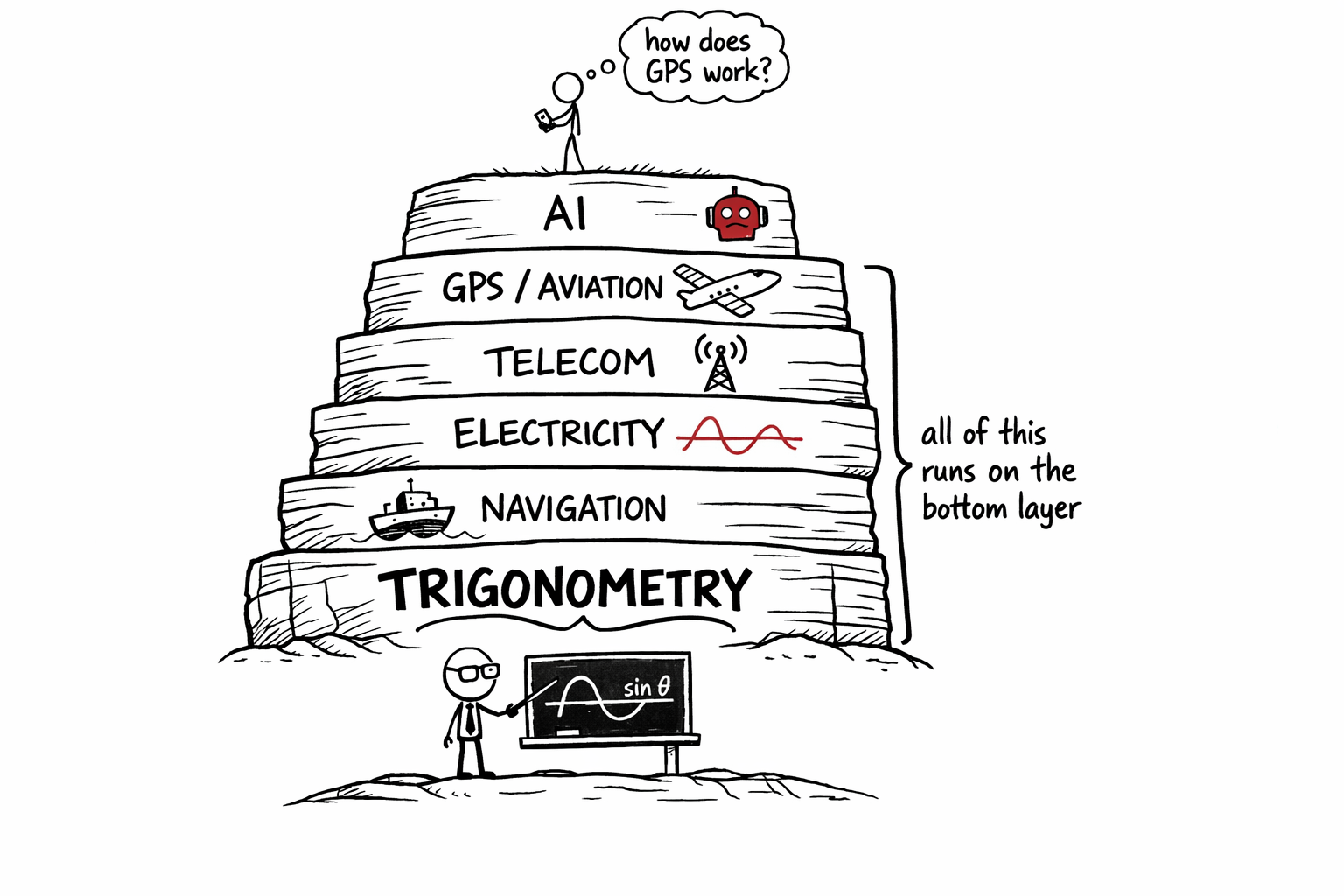
It took me two decades to realize I had it exactly backwards. Trigonometry isn't a subfield of anything. It's the mathematical language the modern world runs on.
And my dad had been teaching it all along.
What would disappear
Here is an interesting question: what would vanish if trigonometry had never been formalized?
Your phone's GPS calculates your position by triangulating signals from satellites. The word "triangulating" isn't a metaphor. It's literally solving triangles in three-dimensional space, thousands of times per second.
The cellular network those signals travel through runs on sine waves. Every call, every text, every byte of data you've ever received wirelessly was encoded and decoded using the same functions my dad taught in a classroom.
The screen you're reading this on compresses and decompresses every image, every video, every song using Fourier transforms, built entirely on sine and cosine. Your CT scan, your MRI, your ultrasound, all reconstruct 3D images from 2D projections using the Radon transform. Trigonometry all the way down. Without it, doctors would go back to cutting you open to see what's inside. Your heartbeat is a trigonometric function. Cardiologists diagnose heart conditions by Fourier-analyzing the sine wave components of your pulse.
Every flight path, every autopilot correction, every instrument landing in zero visibility is calculated using spherical trigonometry. Planes don't fly in straight lines on a map because they fly great circle routes, the actual shortest path on a sphere, computed with trig.
Sound is pressure waves. Sine waves. Spotify, noise cancellation, Auto-Tune, the entire field of audio engineering, all applied trig. Shazam identifies songs by running a Fast Fourier Transform on the audio, decomposing it into component sine waves, and matching the frequency fingerprint. Song recognition is sine wave decomposition. Every 3D game, every Pixar movie, every rotation of an object on screen is matrix multiplication built on sine and cosine. AC electricity is a sine wave by design. The entire power grid, every transformer, every motor, every generator, engineered using trigonometric models.
Getting to the Moon required solving trigonometric equations with enough precision that a capsule traveling 40,000 km/h could hit a target 384,000 km away. Missing by a fraction of a degree meant missing the Moon entirely. D-Day depended on a trig machine. Lord Kelvin built a brass analog computer in 1872, gears and pulleys representing cosine terms in a harmonic series, that predicted tides a full year ahead. Those machines calculated the exact tidal windows for the Normandy landings.
Even the AI models reshaping every industry right now are built on it. Transformers, the architecture behind GPT and Claude, encode the position of every word using sine and cosine functions. Without trig, the model literally can't tell "the dog bit the man" from "the man bit the dog." The technology that feels most like magic is running on math that's 2,200 years old.
Take trigonometry away and you don't lose a branch of math. You lose the ability to describe anything that oscillates, rotates, or propagates through space.
Which is almost everything.
What my dad was actually teaching
My dad's career shift makes more sense to me now than it did when I was fifteen.
Architecture is applied trigonometry. You can't design a roof without understanding angles. You can't calculate load distribution without resolving forces into components. You can't place a building on a slope without understanding gradients.
But architecture was just one application. The ancient Egyptians used trigonometry to build pyramids. In 240 BCE, Eratosthenes measured the Earth's circumference with a stick and a shadow angle, and got within 1%, off by less than 300 km. Navigators used it to cross oceans. Surveyors used it to map continents. Every generation found new things to build with the same tool.
My dad didn't go from building things to teaching abstract math. He went from one application of a fundamental tool to teaching the tool itself.
The students in his class went on to design buildings. But the same math went on to land rovers on Mars, compress every video call you've had in the last three years, and guide surgical robots inside human bodies.
He was teaching a piece of knowledge so deeply woven into how we understand and manipulate the physical world that removing it would collapse most of modern civilization back to roughly the 1700s.
I used to think teaching trigonometry to architecture students was a modest job.
Every time I open a map, stream a song, board a plane, or talk to an AI, I'm using something my dad spent years making sure the next generation understood. I just didn't see it until now.
Written with ❤️ by a human (still)