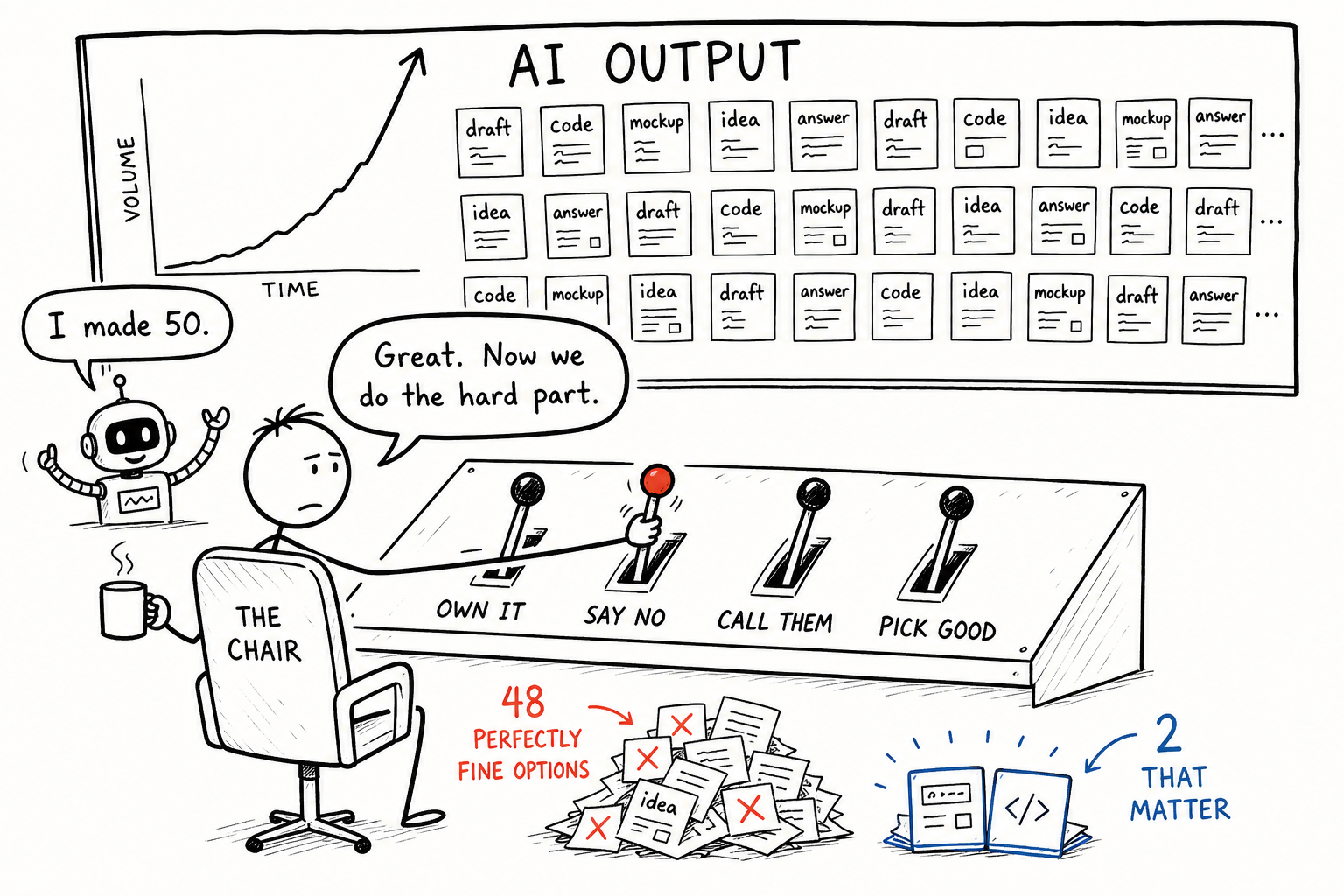
Every week a new model drops and the list of things AI does better than us gets longer. It writes faster. Codes faster. Spits out fifty versions of a design before I've finished my coffee.
So a fair question: what's left for us?
I've been thinking about this for a while. There are four areas where I think humans still have an edge. Maybe not forever, but for a while.
1. Accountability
You can't really hold an AI accountable. Not in any meaningful way.
An AI is a chat session. You open one, get an answer, close it. Two weeks later something goes wrong because of that answer, you open a new tab, and the model on the other side has no idea who you are. You can hand it the context and the memory, but it still isn't the same entity that gave you the call. It didn't lose sleep over it. It can't be fired.
Accountability needs continuity. A person who lives with the consequences. A name on the decision. Someone on the hook when the bill comes due.
That's a uniquely human role, and the bigger the stakes, the more obvious it gets. Nobody is going to let an AI sign off on a billion-dollar acquisition or fire a co-founder. Not because the AI couldn't reason about it, but because there has to be a human in the chair when things go sideways.
2. Saying no
This one matters more than I think people realize.
AI is trained to be helpful. Ask it to build something, it builds it. Ask for an opinion, you get a polite middle. Ask whether to pursue idea A or idea B and it'll cheerfully explain the merits of both. It hedges. It tries to keep everyone happy.
Prioritization is the opposite of that. Building anything good means saying no to most things, including good things. The output isn't a balanced answer, it's a sharp one. Most of the work is killing options.
AI can map the tradeoffs. It can lay out what each path costs and what each one buys. But the actual call, the moment you say "we're not doing this, even though we could," that takes a human with conviction and limited time. Someone willing to walk away from a real opportunity because it's not the opportunity.
A founder who can't say no doesn't ship. A team that can't say no loses focus. AI doesn't fix this, and honestly might make it worse, because now every option is a few keystrokes away.
3. Relationships
Anything built on trust still runs on humans.
You feel it every time you contact customer support and realize, halfway through, that there's a real person on the other end. There's a small lift. Often they don't even have better answers. But they're there. Someone heard you. The opposite is the hollow feeling of an AI reply that sort of addresses your question, except for the part you actually cared about.
Professional life is full of relationships that don't compress. A sales call where someone's deciding whether to bet their career on you. A hard conversation with an investor. A negotiation where the other side is reading you, not the words you're saying. A partnership built on years of small favors and shared context.
AI can draft the email. It can't have the relationship.
As more interaction gets handled by AI, talking to a real human goes from default to premium. The companies that figure out which conversations to keep human are going to have an edge. So will the people who are good at having them.
I don't really see us building deep professional connection with AI. Maybe in personal life. Maybe in some weird future of dating apps and companionship products. But in business, the kind of trust required to do real work together is built between people.
4. Taste
AI can generate fifty versions of a design in five minutes. It can't tell you which one is good.
This is the part that gets me. The cost of producing things has collapsed, and the cost of judging them hasn't. Which means the ability to look at twenty things and pick the right one is becoming one of the most valuable skills on the table.
Taste isn't a vibe. It's a function of what you've seen. A designer who's used a thousand interfaces can spot the two that feel right. A writer who's read a thousand essays knows which sentence to cut. You build taste by paying attention to what actually works versus what only looks good on paper.
The analogy I keep coming back to is the Michelin chef. The chef at the top doesn't cook most of the food anymore. They walk the line, taste plates, send things back. Their job is to know what good is and refuse anything that isn't.
That's the role AI is putting more of us in. Less time producing, more time selecting. The people who win in this world have the strongest deselection muscle. They can look at fifty AI-generated options and confidently throw forty-eight away.
Taste is also the hardest of these four to fake. You either have it or you're building it. And you build it the way you always did, by paying attention, forming opinions, and checking them against reality.
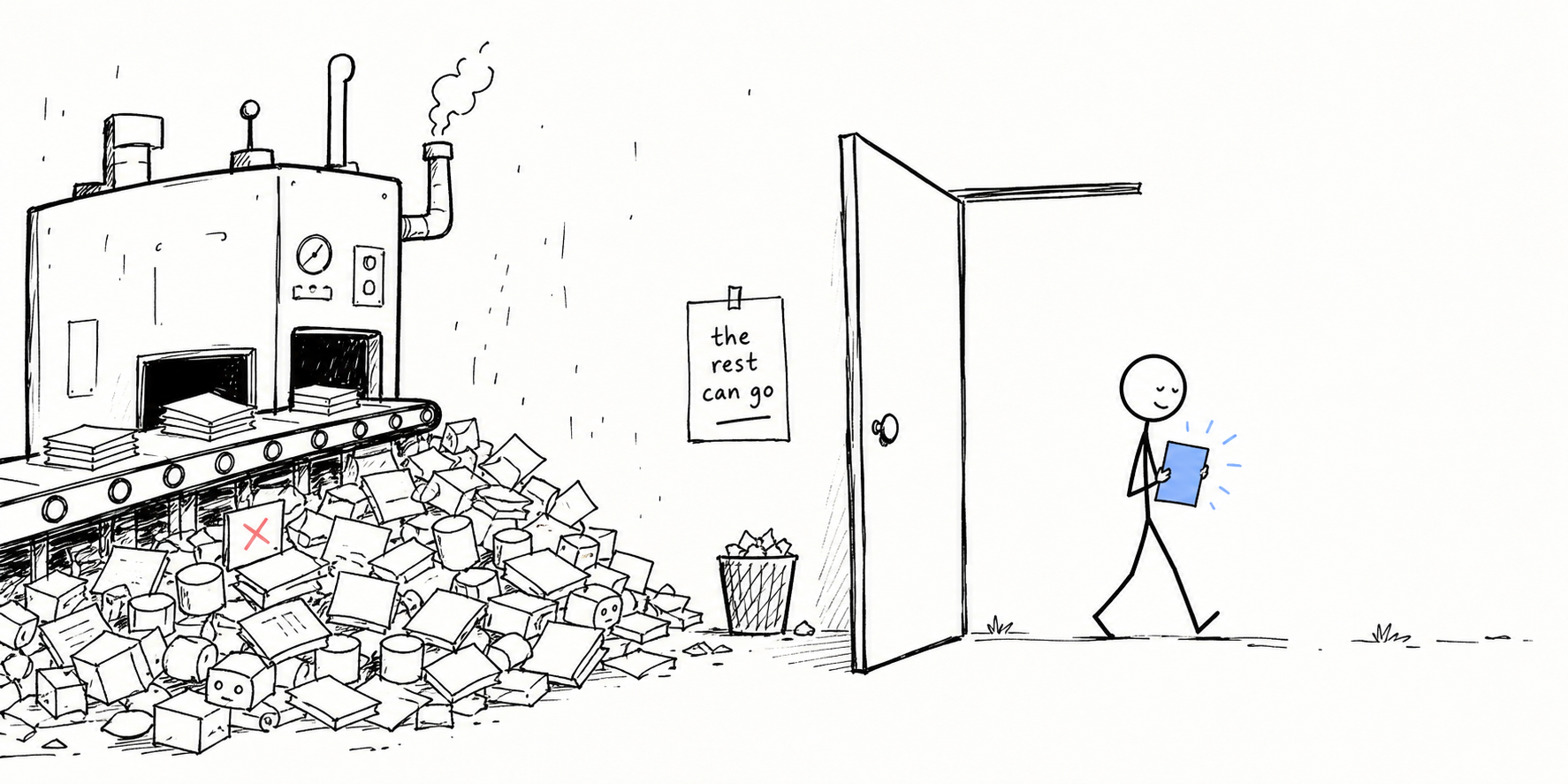
None of this is permanent. The models keep getting better, and some of these edges will narrow.
But the work that's left, making the tough calls, saying no, building relationships, having good taste, is also the part I find most enjoyable anyway. The rest can go to the machines.
Written with ❤️ by a human (still)