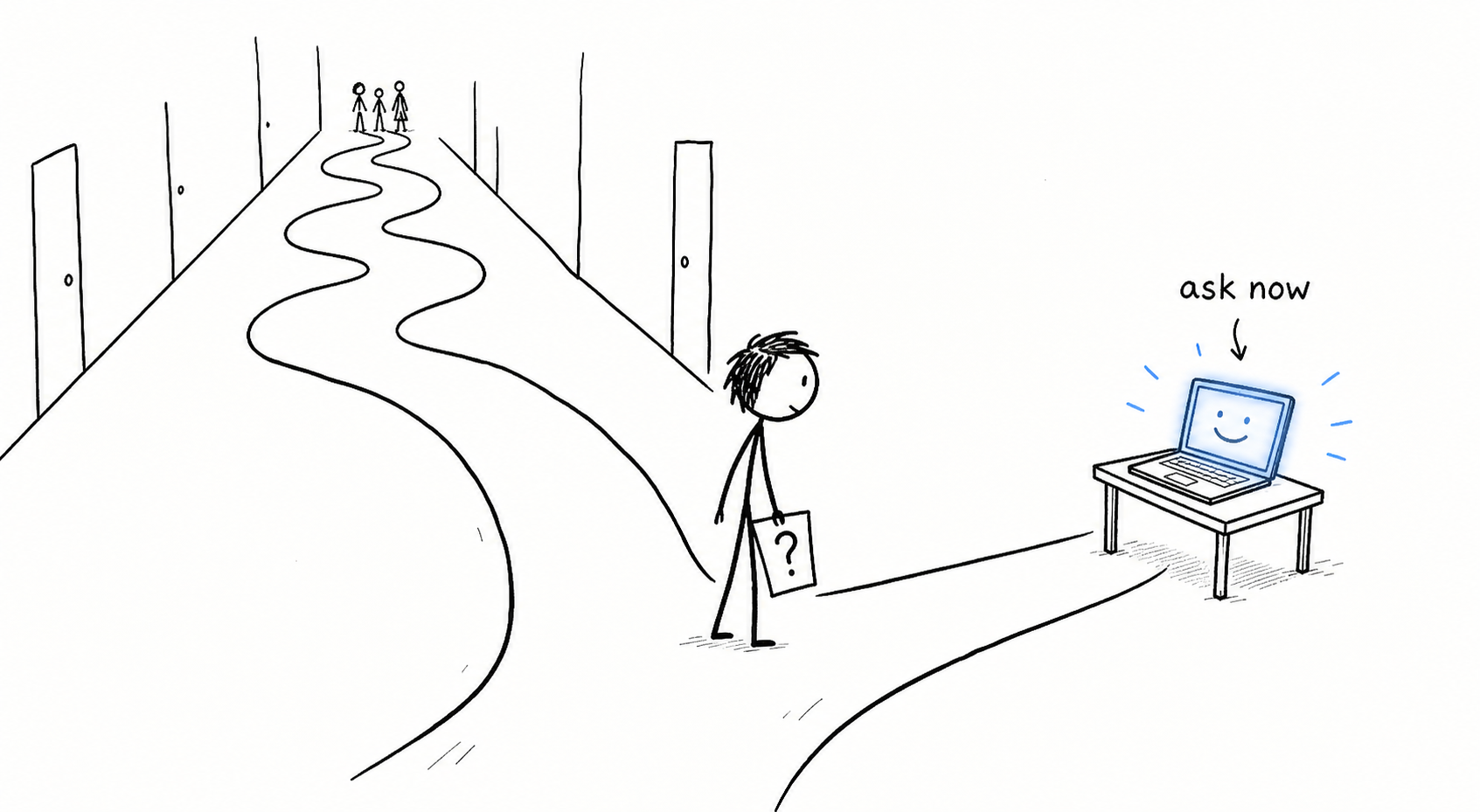
I've been thinking about this question: why would a kid go to AI before going to a teacher, a therapist, or even a parent? The obvious answer is convenience. It's on the phone. It's cheap. It's fast. But I think that's underselling it.
The real reason is that AI is good at three moments where humans, even very good humans, have a hard time competing. It is there when the question happens. It can keep changing the words until something lands. And it doesn't make you feel stupid for asking. That's basically the whole thing.
I don't mean AI is better than a great teacher or a great therapist. It isn't. A great teacher can read the room. A great therapist can hear what you're avoiding. A parent can notice your face, take the phone away, drive to the school, call the doctor, sit next to you in silence. There are whole categories of care that require a human body and a human relationship.
But a lot of learning and emotional support doesn't happen in those big dramatic moments. It happens in tiny ones. A kid gets stuck on a word. A teenager starts spiraling at midnight. Someone has a question they don't want to ask in front of the class. Someone needs the same thing explained again, but in a way that doesn't make them feel like an idiot.
Those are the moments where AI starts to look weirdly strong.
The first thing is timing
Therapy has a timing problem.
You feel awful on Tuesday night and your therapist is available Thursday at 6.
That's not a criticism of therapy. It's just reality. Therapists have other patients. They sleep. They have families. They cannot sit in your pocket waiting for the exact second your nervous system decides to ruin the evening. AI can. And I think we underestimate how big that is.
When you're anxious or ashamed or lonely or angry, the next ten minutes matter. If you're about to send a text you shouldn't send, or you're spiraling about something someone said, or you suddenly feel like everything is falling apart, help three days from now is not the same thing as help right now.
Teaching has the same problem, just less dramatically.
A kid is doing homework. Something almost makes sense. Then one symbol appears, or one word in the question feels weird, or the teacher skipped a step because the rest of the class seemed to get it.
Maybe the kid raises their hand. But often they don't. Maybe class is over. Maybe the teacher is busy. Maybe they're at home. Maybe they're scared the question will make them look stupid. So the question dies.
That sounds small, but I don't think it is. Curiosity has a short shelf life. Confusion hardens pretty quickly into "I'm bad at this." If you answer the question while the kid is still inside the problem, you might unlock something. If you answer it next week, you're often too late.
This is why AI feels less like Google and more like a private tutor.
Historically, private tutors were for rich families. And yes, part of the value was that the tutor knew the subject. But the bigger thing was the ratio. One child, one adult, one explanation at a time. If the child got stuck, the tutor stopped. If the example didn't work, they tried another one.
Schools made education available to everyone, which is incredible. But they did it with a brutal ratio: one teacher, many kids.
AI changes the ratio again.
It can be wrong. It can make learning too easy. It can absolutely teach badly if it just hands over answers. But it has one advantage no human system can match at scale: it answers while the question is still alive.
The second thing is language
These systems are called large language models for a reason. Language is what they do.
Now, to be clear, this is not because the model has empathy. The attention mechanism is not "attention" in the human sense. It doesn't care about you. Roughly, it helps the model decide which parts of the conversation matter when predicting the next words.
But from the user's side, the effect can feel very personal.
You can ask it to explain fractions like you're ten. Then like you love football. Then like you hate math. Then with pizza. Then without pizza because now the pizza example is annoying. It will keep going.
Most humans can't do that for very long without getting impatient.
And this is where the teacher and therapist thing connects. Because often the difference between "I don't get it" and "Oh, wait, now I get it" is not a new idea. It's the same idea said in the right words.
"You're catastrophizing" might be technically correct and completely useless.
"Your brain is treating uncertainty like proof that something bad is happening" might actually help. Same idea. Different words.
Good teachers do this. Good therapists do this. They search for the sentence that works on the person in front of them.
AI is not better at this because it cares more. It doesn't care. That's the strange part. It's better at trying again.
It can rephrase without ego. It can slow down without feeling insulted. It can explain the same thing five different ways and never secretly think, "How do you still not get this?"
For kids, that's a big deal. A lot of what looks like stupidity is just a bad match between the explanation and the child. One sentence misses. Another sentence lands. Suddenly the kid is not "bad at math" anymore. They just needed a different door into the room.
AI creates a lot of doors.
The third thing is shame
This is the one I keep coming back to. AI feels less judgmental.
I said "feels" because obviously there are real risks here. The conversation may not be private. The company behind the model may not deserve that much trust. Kids pouring their inner lives into a chatbot is not some obviously healthy thing we should just wave through. But the feeling is different.
With a therapist, even a good one, there can still be a bit of theater. You know they're trained not to judge you. You may even believe them. But part of you is still watching yourself talk.
Was that too dramatic? Did that sound pathetic? Will they think less of me?
With a teacher, it's even more obvious. Everyone says there are no stupid questions because everyone knows exactly what a stupid question feels like.
So kids stay quiet.
They don't ask what the acronym means. They don't admit they missed last week's concept. They don't ask why the minus sign moved. They protect the image and keep the hole.
AI removes the audience.
I remember this happening to me while I was trying to understand something fairly technical about AI. People kept talking about the "KV cache" in transformer inference as if it was obvious. And I had this stupid little moment of, wait, do I actually know what that means? If a human had been explaining it to me, especially someone technical, I probably would have nodded along for a while. Not because they would necessarily judge me, but because I would be afraid they might. With AI, I just asked. What is the KV cache? Why does it matter? Explain it like I understand transformers but not this part. Then explain it again more slowly. There was no social cost to admitting the gap.
You can ask the embarrassing question. You can ask it badly. You can ask it five times. You can say, "I still don't get it," without watching another person's face react.
For teenagers, this is huge. Adolescence turns everything into performance. Every feeling is too much. Every confession feels risky. Every social mistake feels permanent, at least for a while.
So of course a patient, faceless, always available thing becomes attractive.
That's the part I find both powerful and unsettling. People will say more to something that cannot judge them. But they will also say more to something that cannot be responsible for what happens next. Both are true.
I don't think this means AI replaces humans
The boring version of the argument is: AI will replace teachers and therapists. I don't think that's right. The more interesting version is that AI becomes the first place kids go. Before the teacher. Before the therapist. Before the parent.
And the first place matters. It shapes the question. It shapes the language. It shapes what the kid thinks is normal. If the first response to confusion is an AI answer, and the first response to anxiety is an AI conversation, the tool is not just helping with homework or mood. It is helping form the child's inner voice.
Maybe that's good. Maybe every kid gets something like a private tutor. Maybe every teenager gets somewhere to put the feeling before it turns into something worse.
Maybe it's bad. Maybe it teaches them to outsource confusion too quickly. Maybe it makes the most available "adult" in their life a product made by people they will never meet.
I genuinely don't know.
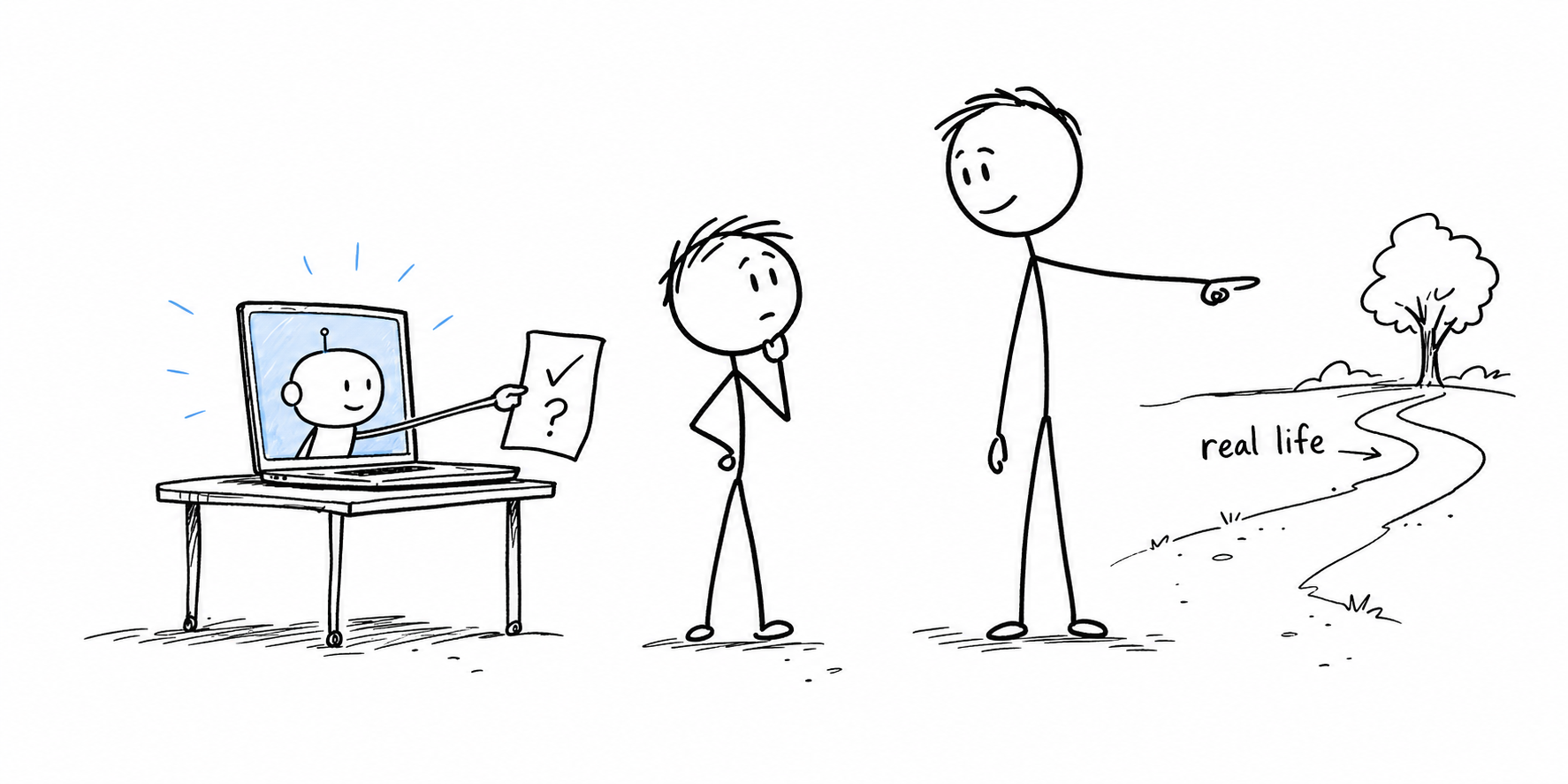 First answer, not final adult
But I do think humans are going to lose if they try to compete on the same dimensions.
We can't be available all night for everyone. We can't endlessly rephrase for millions of children at once. We can't remove the small risk of shame that comes from being seen by another person.
So the human role has to be different.
Presence. Responsibility. Memory. Love. Authority. The ability to notice what is not being said. The ability to intervene when words are no longer enough. The ability to say, "Close the laptop, we're going for a walk," and actually mean it.
A teacher can create a classroom culture. AI can't.
A therapist can hold a boundary and be accountable for care. AI can't, at least not in the way a licensed human can.
A parent can hug the child, drive to the school, take the phone away, remember what happened last winter, and notice the tone of voice at breakfast.
Those things still matter. Maybe they matter more once the cheap, always-on version of help exists.
But if a kid turns to AI first, it won't be because AI is human. It will be because it's there at the exact moment the question is still warm. It has another way to explain it. And it doesn't make them feel stupid for asking.
Written with ❤️ by a human (still)